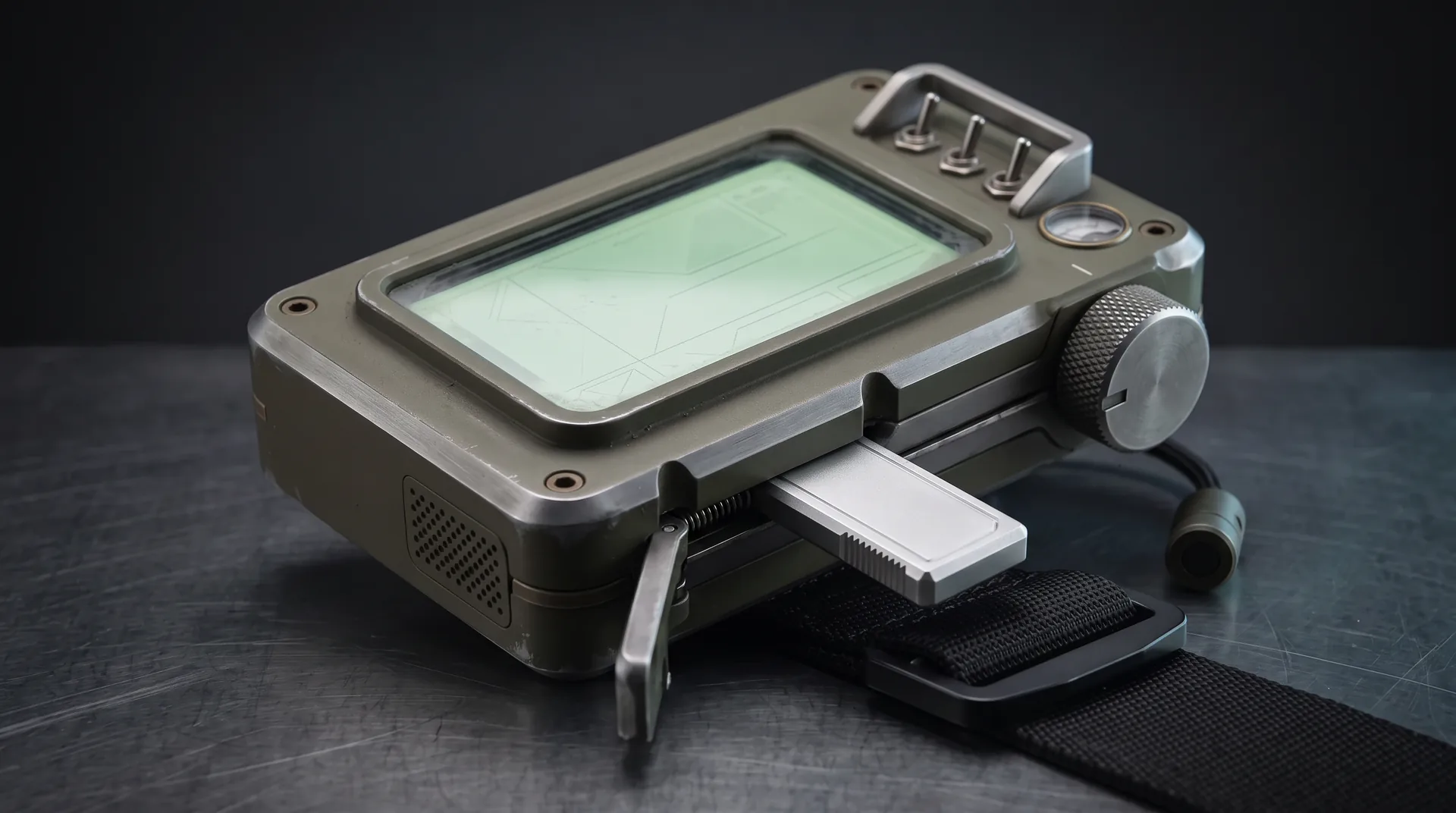
SYS‑2026 · Concept study · Not a shipping product

When the network goes down, this doesn’t.

A wrist-mounted field terminal with its own radio, its own maps, its own sensors and its own power. No cell tower. No account. No monthly fee. It is a computer you can service with a 2 mm hex key.

Standby
9 days
Mesh range
12 km
Sealed to
IP68 · 2 m
Mass
486 g

Scroll

00 / Power on

Eleven seconds
from cold.

No account to sign into, no pairing, no waiting on a handshake with a server that may not answer. It checks its own hardware, tells you what it found, and hands you the screen.

The sequence below runs by itself the moment it reaches you, at the speed the hardware would actually take.

POST Power-on self test 0%
  1. ROM v4.11 · 512 KB verified
  2. PWR 11 600 mAh · cell balance nominal
  3. DSP 640 × 480 transflective · backlight off
  4. DET GM tube 480 V bias · plateau reached
  5. NAV GNSS 21 sv tracked · magnetometer trimmed
  6. RF 868 MHz mesh up · receiver 150 kHz–1.7 GHz
  7. BIO PPG puck seated · skin contact good
  8. CRT cartridge A · 61.4 GB free
All subsystems nominal. Terminal ready.

01 / Hardware

Six things bolted
inside one case.

01

Transflective display

3.5″ monochrome · 640 × 480 · no backlight required

The brighter it gets outside, the more readable it becomes — it reflects sunlight instead of fighting it. Holding a static screen costs about 40 µA, which is why standby is measured in days.
02

Ionising-radiation detector

Halogen-quenched Geiger–Müller tube · 0.01–1000 µSv/h

A real glass tube, not an estimate from a chip. It clicks because a particle actually hit it. Dose rate, accumulated dose, and a rate alarm you set yourself.

03

Navigation stack

Multi-band GNSS · 3-axis magnetometer · barometric altimeter

Vector maps live on the cartridge, so position, heading and altitude never touch a server. It knows where you are in a canyon with no signal because nothing about it needed signal.

04

Radio, both directions

Sub-GHz mesh transceiver · 150 kHz–1.7 GHz receiver

Short text and position hops unit to unit — up to 12 km line of sight, further through the mesh. Separately, a receive-only tuner for emergency broadcast, marine, air band and shortwave.

05

Biometric puck

Reflective PPG · SpO₂ · skin temperature

Pressed against the underside of the forearm, where the signal is cleaner than at the wrist bone. Heart rate, oxygen saturation and core-temperature drift — logged locally, uploaded nowhere.

06

Cartridge bay

microSD in a machined aluminium shell · hot-swappable

Maps, logs, waveforms, firmware. Eject it with a gloved thumb and hand it to somebody. That is the entire sync protocol, and it works in a blackout.

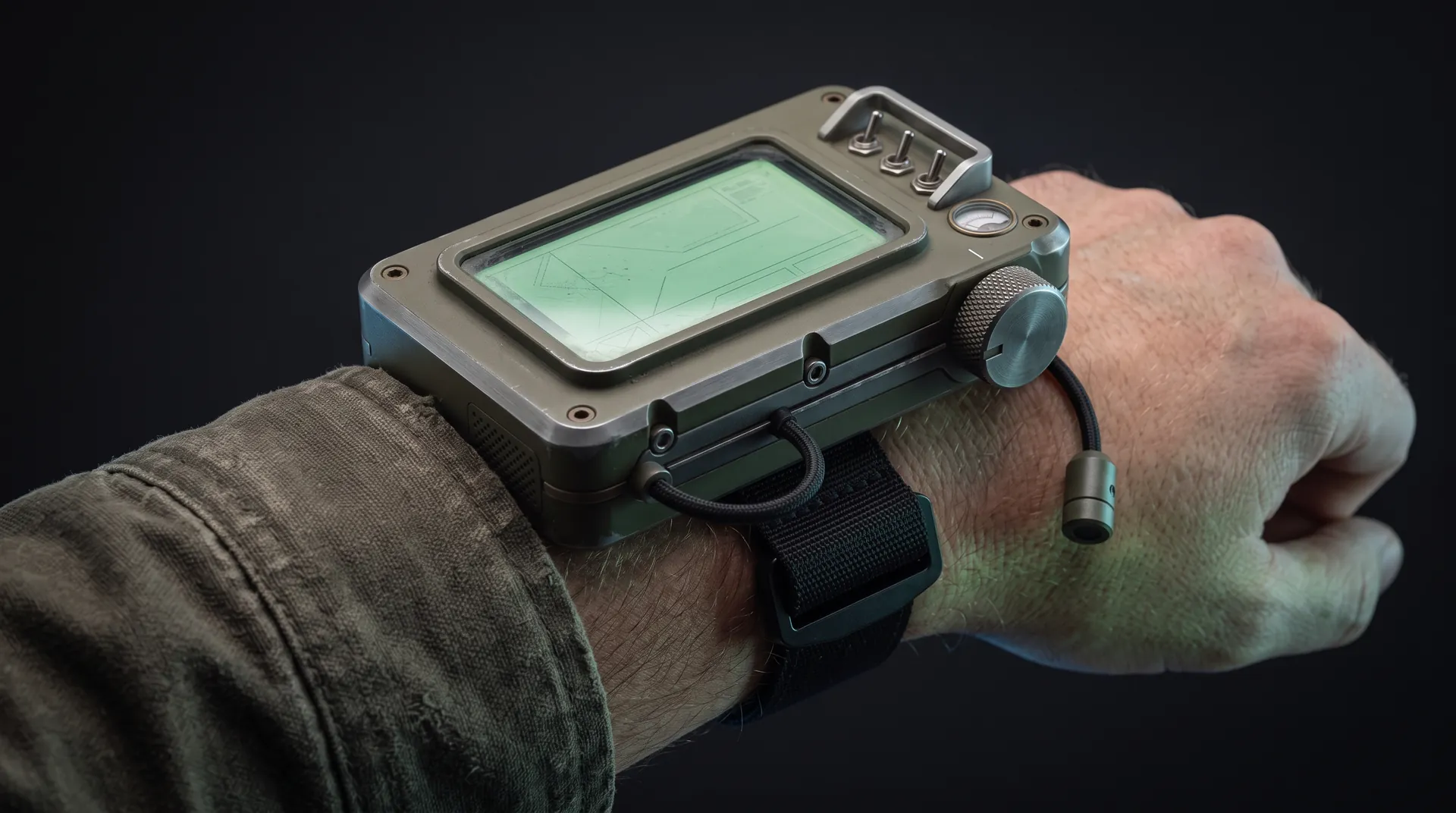
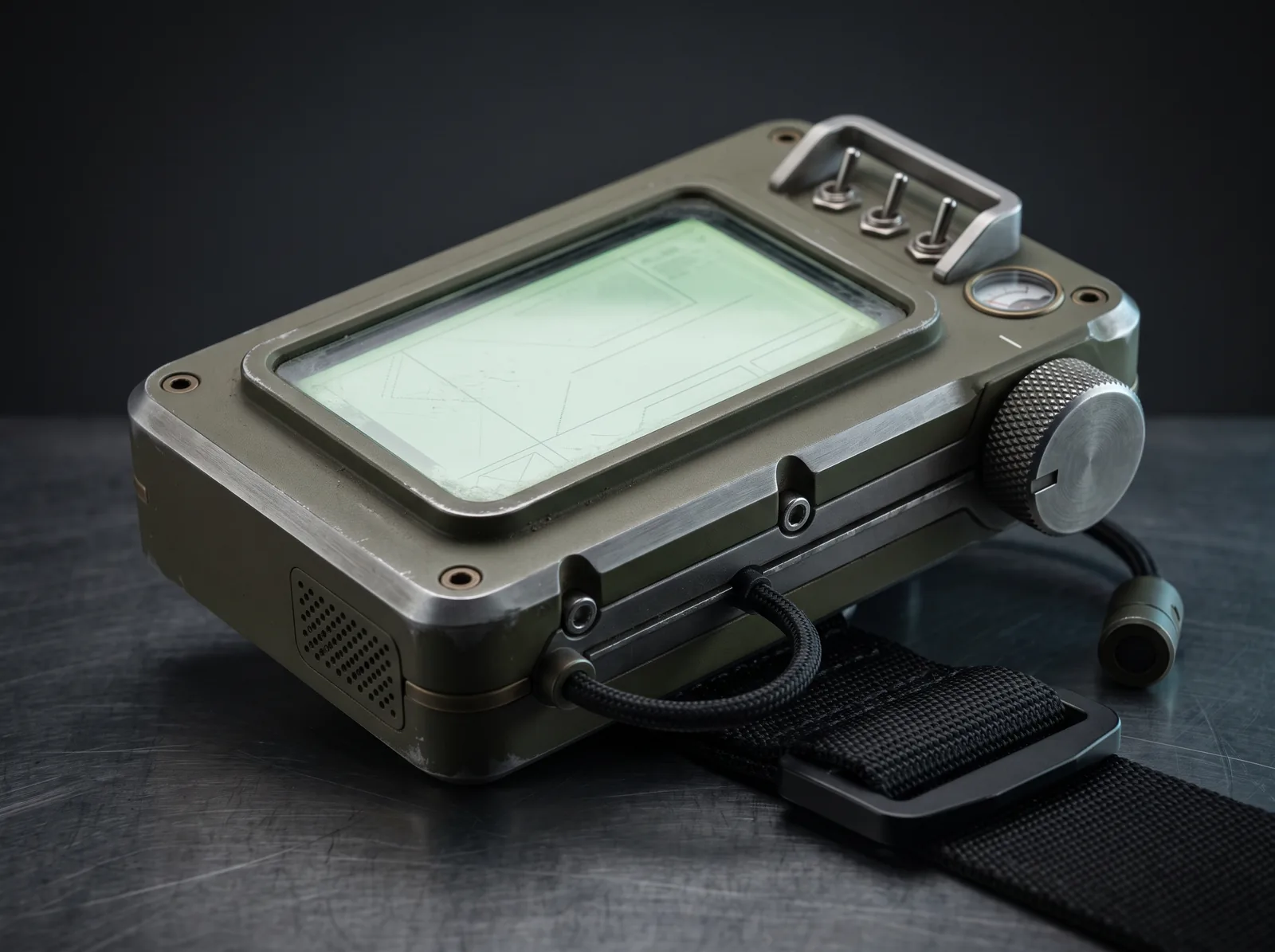
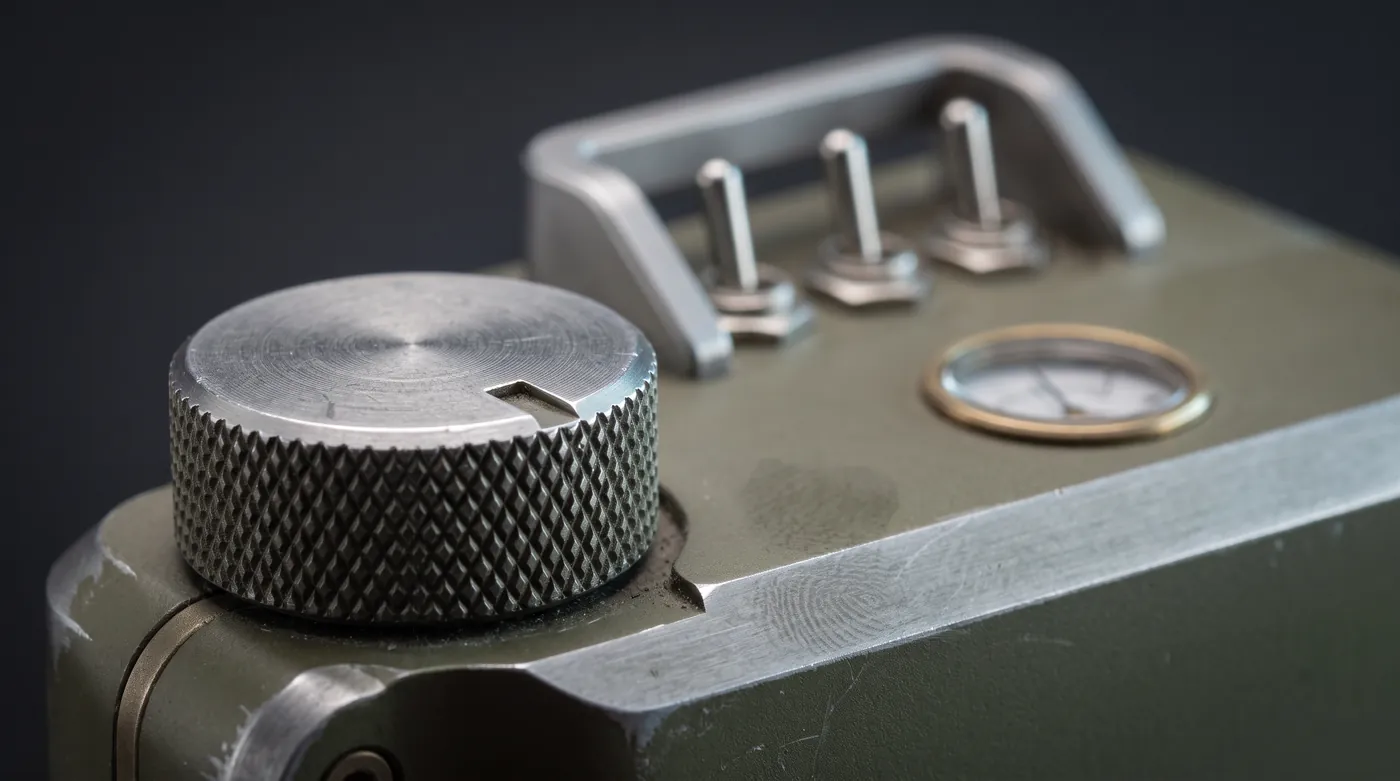
Macro photograph of the knurled aluminium dial, the three toggle switches under their guard rail and the small analogue gauge.
Gloves stay on. One dial, three toggles, no touchscreen. Every control has a detent you can feel through 3 mm of neoprene.
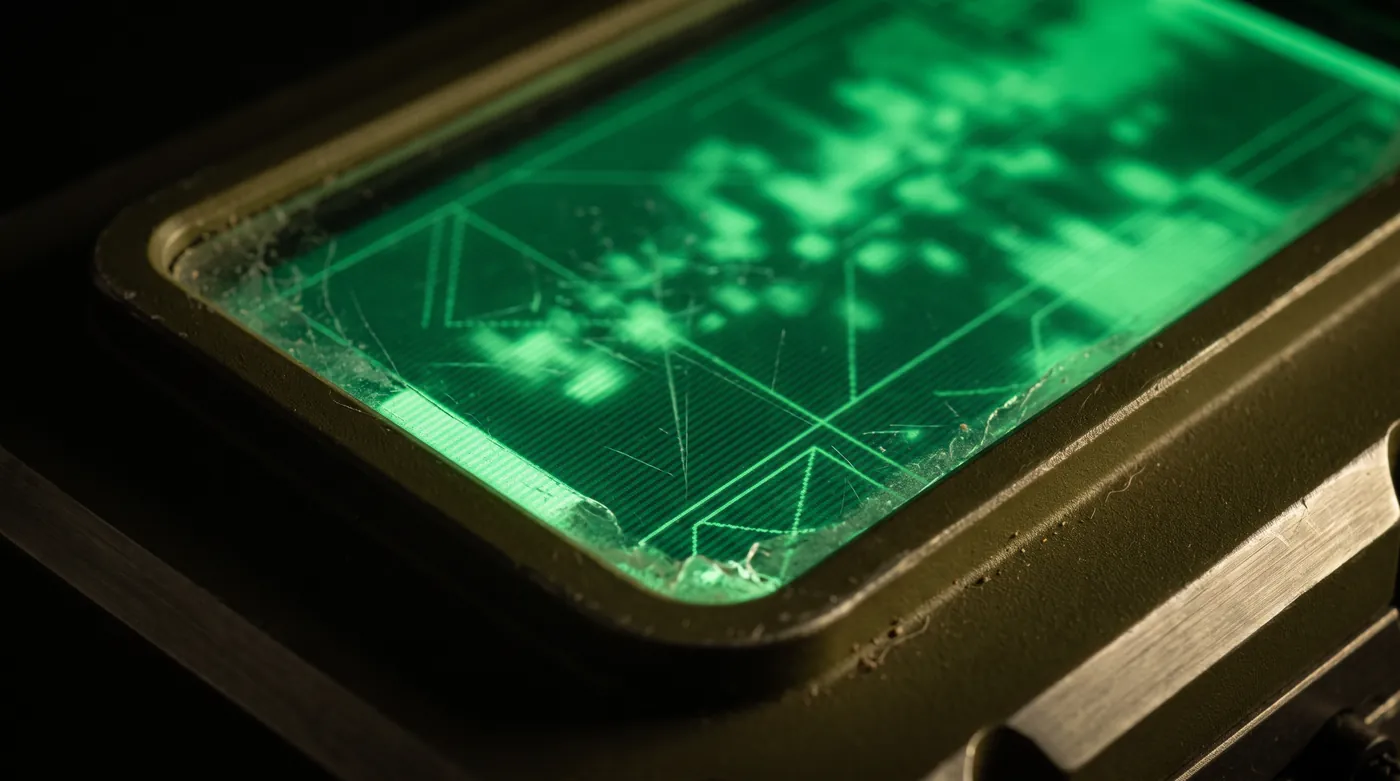
Macro photograph of the display: scratched cover glass over a green phosphor screen with visible scan lines.
Scratches are fine. The cover glass is a sacrificial part. Two screws, ninety seconds, and it is new again.

02 / The interface

Six modes. One dial.
Nothing hidden in a menu.

This is the actual screen, running in your browser. Turn the dial, flip a switch, or use your arrow keys — the terminal responds the same way the hardware would.

RAD --:--:-- BAT 87%

0.11

µSv/h · BACKGROUND

  • Accumulated0.0043 mSv
  • Alarm at2.50 µSv/h
  • TubeGM · 480 V

Sheet 14-C loaded from cartridge · offline

    4 units in range · 868 MHz · last hop 2.1 km

    162.550

    MHz · VHF WX

    • Signal████░
    • ModeReceive only
    • Heart rate64 bpm
    • SpO₂98%
    • Skin temp33.8 °C
    • ContactGood
    • maps/sheet-14c.vmap412 MB
    • logs/dose-2026-08.csv1.1 MB
    • logs/track-0841.gpx318 KB
    • rf/scan-vhf.iq96 MB
    • fw/sys-4.11.img512 KB

    Cartridge A · 61.4 GB free · safe to eject

    TURN DIAL OR PRESS ← →
    SCREEN OFF

    SYS-2026 · UNIT 001 · ASSY 06

    Dial drag or scroll it ← → step through modes Switches power, backlight, phosphor

    Why it works like this

    Radiation is the one number that has to be readable at arm’s length, so it gets the whole top half of the screen and nothing else competes with it.

    Mode: RAD.

    03 / Construction

    Built like infrastructure,
    not like a phone.

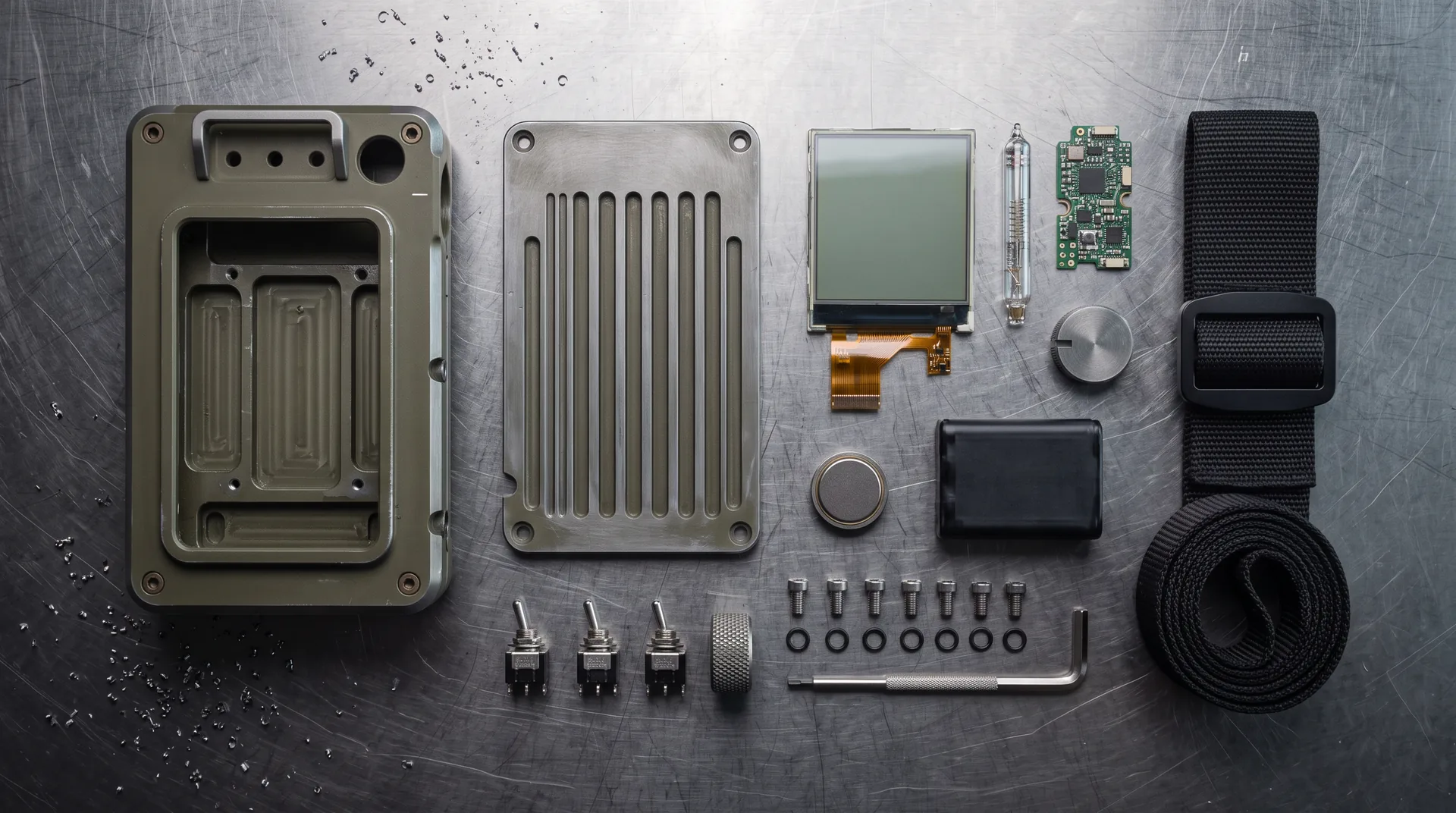
    Twenty-two parts. Nine of them user-replaceable with a hex key that ships in the strap. Nothing is glued, and nothing is paired to a serial number.

    Overhead teardown: the machined chassis, ribbed rear cover, display module, Geiger tube, circuit board, coin cell, battery, dial, toggle switches, fasteners, hex driver and nylon strap laid out in a grid on a steel bench.
    Every part in a production unit, laid out in assembly order.

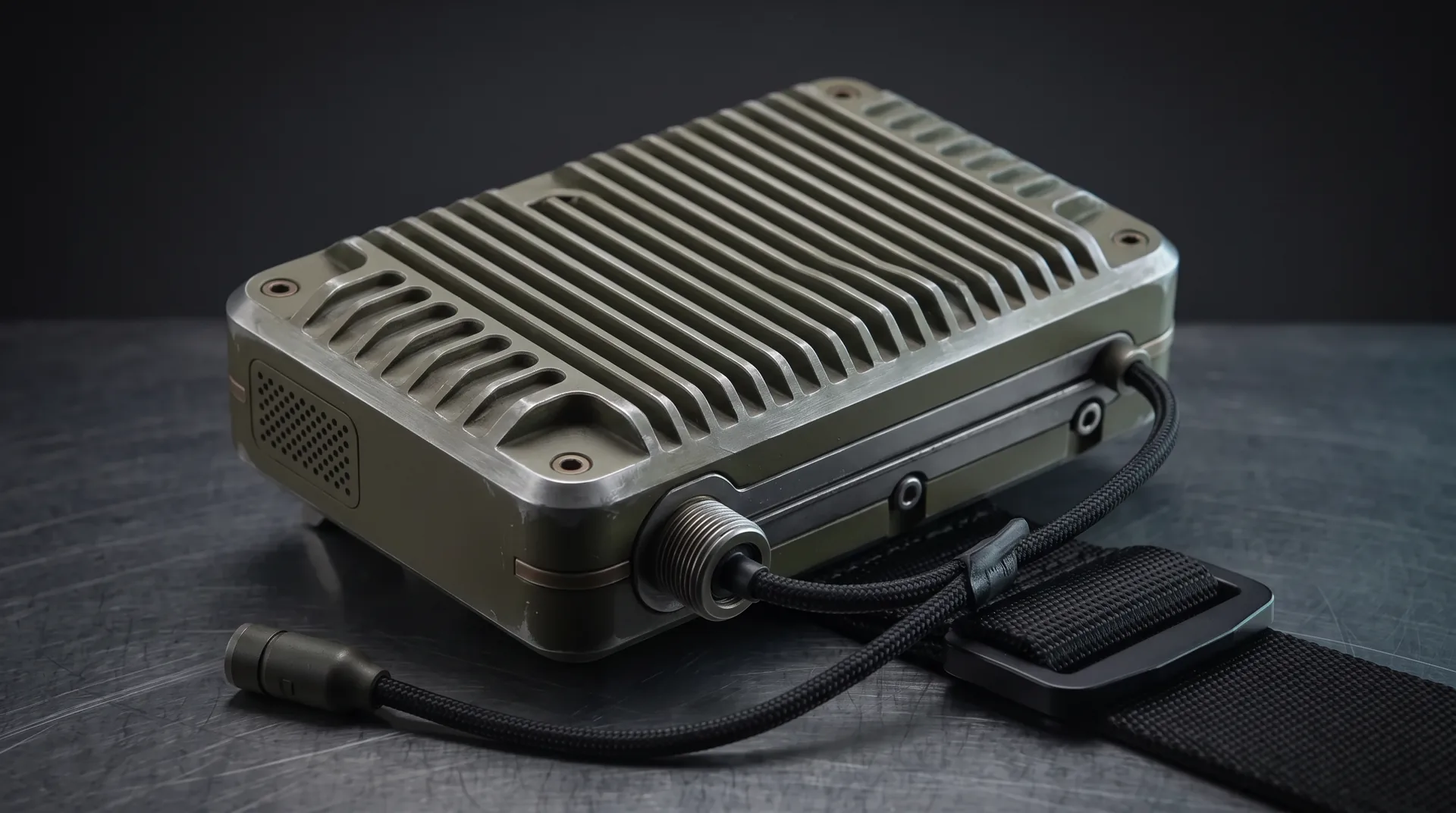
    6082‑T6 aluminium, cut from billet

    A 1.9 mm minimum wall, cerakote over hard anodising, and chamfers wide enough to take a drop on the corner without deforming the seal groove. It is heavier than it needs to be, deliberately.

    One gasket, one seam

    A single captive O‑ring in a machined channel means one thing to inspect and one thing to replace. Sealed to IP68 at two metres for an hour, and it still opens with a hex key.

    Power you can carry spare

    An 11 600 mAh pack that lifts out in one piece — forty hours of mixed use, nine days idle, and roughly three weeks if you leave it on the detector alone.

    Serviceable on a tailgate

    Display, glass, battery, strap, dial and cartridge door are all separate line items. No adhesive, no proprietary driver, no board-level pairing.

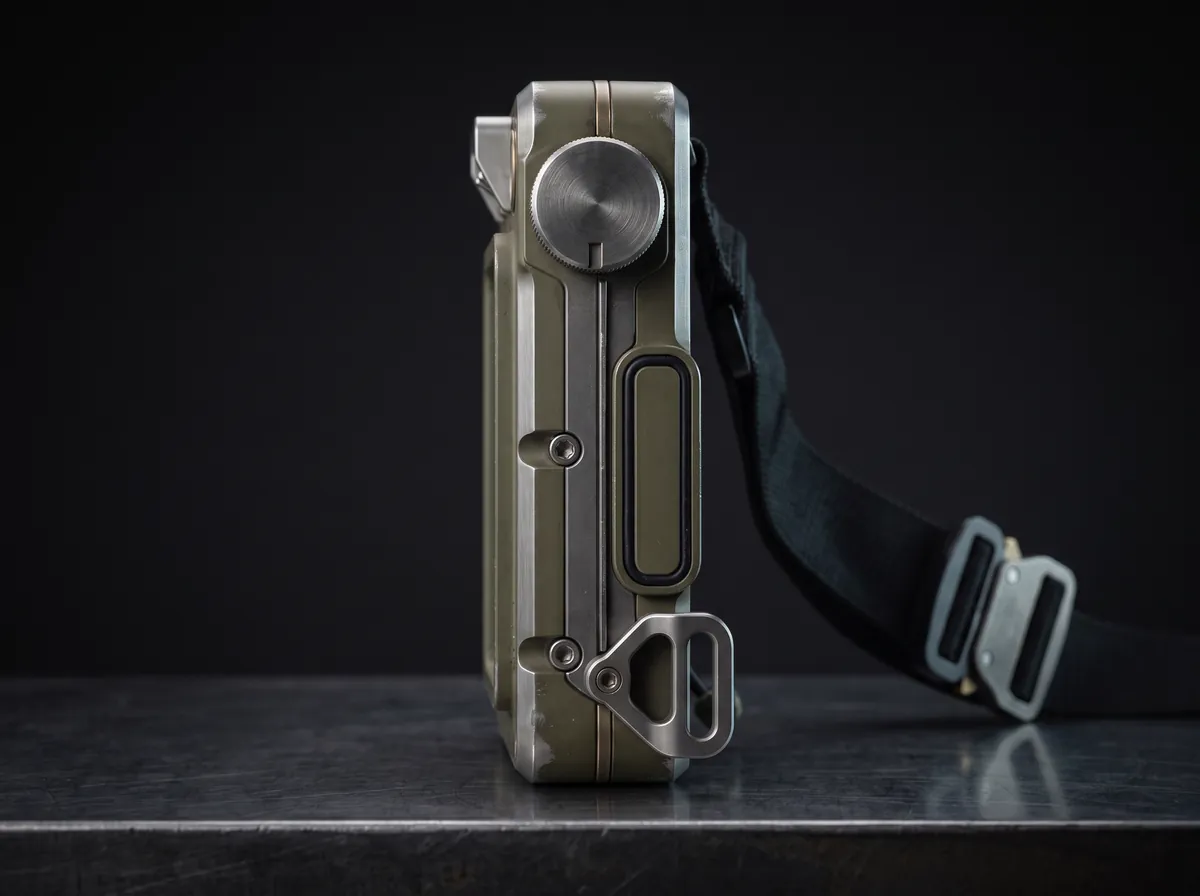
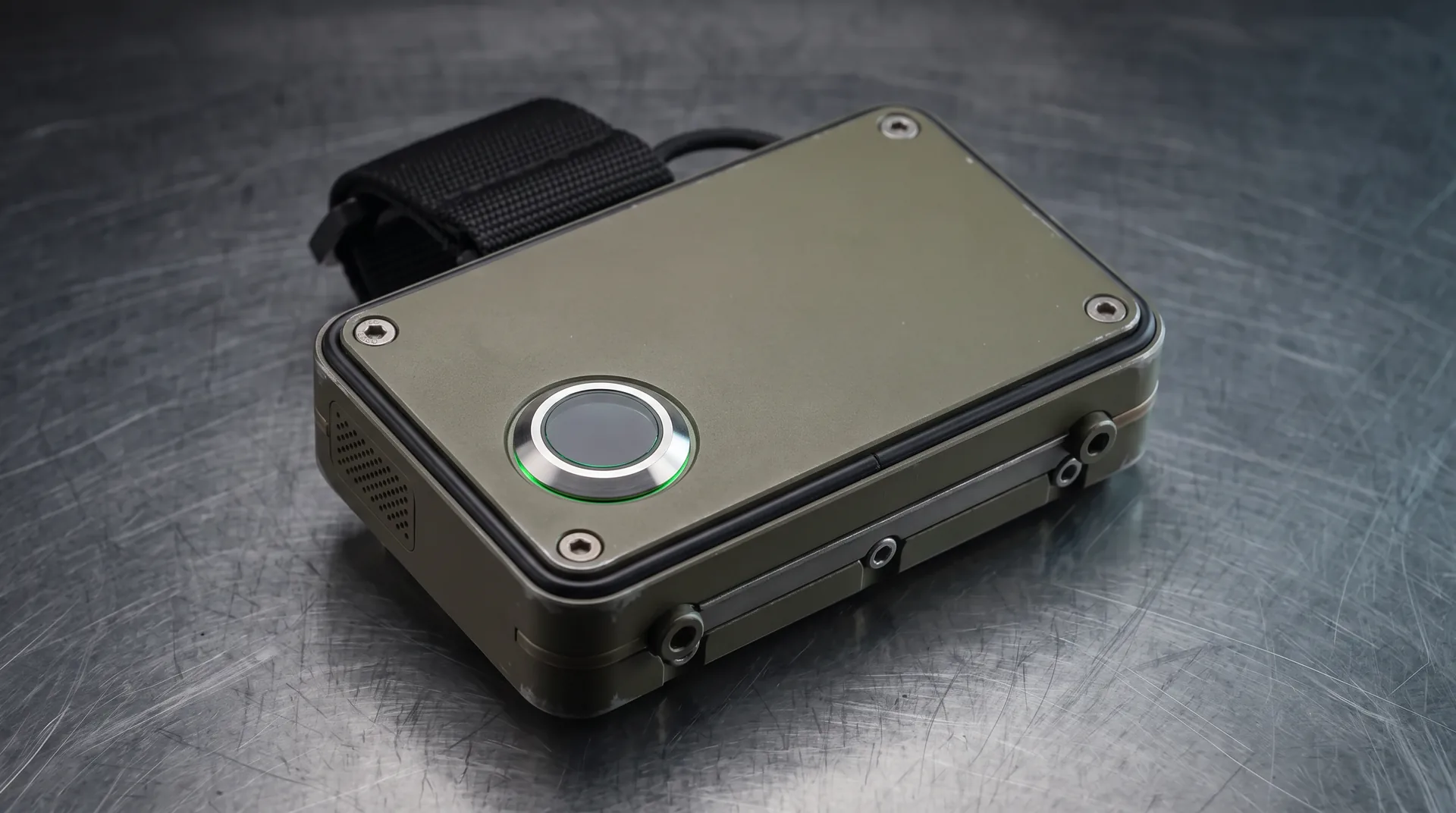
    The terminal stood on its edge, showing the full thickness of the case, the seam line, hex fasteners, a sealed port cover and the strap lug.
    28.4 mm thick at the seam. The port cover is a captive part — you cannot lose it.

    04 / Honesty

    What’s real,
    and what isn’t.

    The fun of a wrist computer is imagining it does everything. Most of this one is off-the-shelf engineering that already exists. Some of it is not, and pretending otherwise would be the cheap way out.

    Real today Built from parts you can buy

    • Geiger–Müller detection: handheld dosimeters have used the same tube design for seventy years.
    • Sub-GHz mesh messaging: long-range low-bandwidth radio mesh is an ordinary, licence-free technology.
    • Offline vector maps + GNSS: every serious handheld navigator already does this without a network.
    • Wideband receive: software-defined receivers cover this range on a chip the size of a stamp.
    • PPG heart rate & SpO₂: the same optical sensing in any fitness band, moved somewhere it reads better.
    • Transflective monochrome LCD: the reason old handhelds ran for weeks on two AAs.
    • IP68 machined enclosure: routine for dive and survey instruments.

    Still fiction Kept because it looks good

    • Diagnosing an injury from your wrist: a sensor can flag that something is wrong. It cannot tell you what.
    • Targeting assistance: entertaining on screen, meaningless strapped to a forearm.
    • Naming an unknown chemical: that needs a spectrometer and a bench, not a wrist.
    • Decades on one cell: the physics is not close, and any product claiming it is lying.
    • Opening doors and machinery: possible over short-range radio, but nobody would let one device hold all those keys.

    And the honest disclosure: SYS‑2026 does not exist. This page is a website template built to show what a product launch can feel like — the photography is generated, the figures are invented but internally consistent, and the reserve form below takes no money and sends nothing anywhere.

    05 / In use

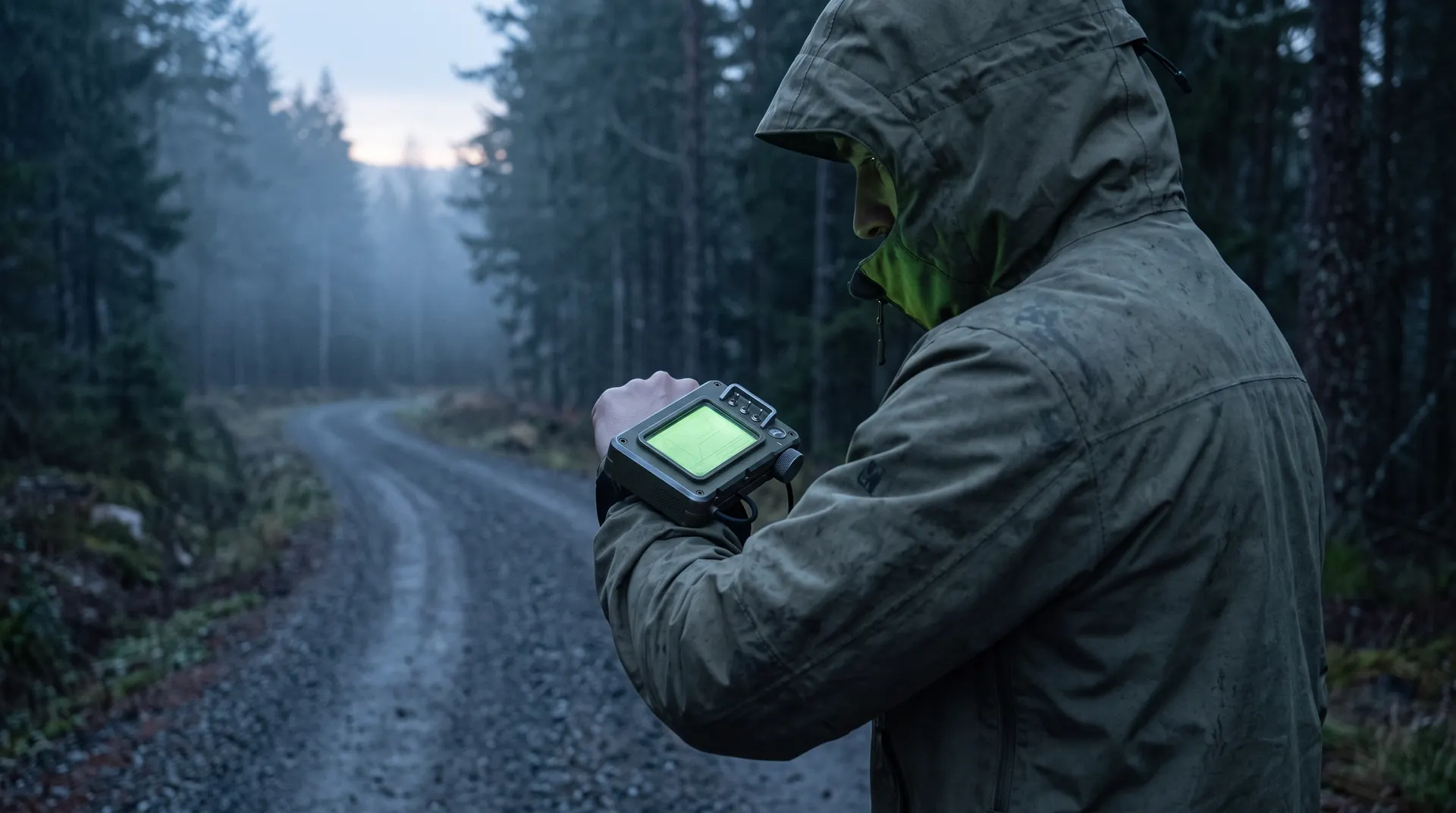
    Blue hour, no bars,
    forty kilometres in.

    The map is on the cartridge. The heading comes from a magnetometer. The message to the other unit goes out at 868 MHz whether or not a single tower is standing.

    • −30°C cold start
    • +60°C sustained
    • IP68 2 m / 1 h
    • 1.5 m drop to concrete
    • 40 h mixed use

    06 / Specification

    The whole sheet.

    Display & controls
    Panel3.5″ transflective monochrome, 640 × 480, 60 Hz
    Cover2.4 mm chemically strengthened glass, replaceable
    IlluminationEdge-lit, 5 levels, red-safe at level 1
    ControlsDetented rotary dial, 3 sealed toggles, 1 recessed reset
    Sensing
    RadiationHalogen-quenched GM tube, 0.01–1000 µSv/h, ±15%
    PositionMulti-band GNSS, 1.4 m CEP typical, cold fix < 28 s
    Heading3-axis magnetometer, tilt compensated, ±2°
    AltitudeBarometric, ±1 m relative
    BiometricsReflective PPG, SpO₂, skin temperature ±0.2 °C
    Radio
    Mesh868 / 915 MHz, +22 dBm, 12 km line of sight
    Receiver150 kHz – 1.7 GHz, AM / FM / SSB, receive only
    Short rangeBLE 5.4 for firmware only, off by default
    Power & body
    Cell11 600 mAh Li-ion, user-replaceable, USB-C 30 W
    Runtime40 h mixed · 9 days standby · 21 days detector only
    Chassis6082-T6 aluminium, hard anodised + cerakote
    SealingIP68, 2 m for 1 h, single captive O-ring
    Dimensions132 × 94 × 28.4 mm
    Mass486 g with strap and cartridge
    Storage64 or 256 GB machined cartridge, hot-swappable

    07 / Configure

    Build the one
    you would actually carry.

    Configure your terminal. Every option updates the total as you go.

    Finish
    Screen phosphor — changes the demo above
    Strap
    Cartridge

    08 / Questions

    The ones that
    actually get asked.

    Is this a real product I can buy?
    Why a monochrome screen in 2026?

    Because a transflective panel gets more readable in bright sun and costs almost nothing to hold an image. A colour screen would halve the runtime and be harder to read on a glacier.

    What happens with no signal at all?

    Everything except the mesh keeps working, and the mesh only needs another unit, not a tower. Maps, detection, navigation and logging never had a network dependency to lose.

    Does it send my data anywhere?

    There is nowhere to send it. Logs live on a cartridge you can pull out with a gloved thumb. Bluetooth exists for firmware and is off unless you flip it on.

    486 grams is heavy.

    It is. That is the cost of a metal case, a replaceable cell and a glass detector tube. A lighter version of this device would be a different, more disposable device.

    Who is it for?

    In the fiction: survey crews, back-country guides and anyone whose job continues after the infrastructure stops. In reality: a design study about what that product would look like.